

No. 024 · 20 November 2026
Is cash freedom?
Who built each country’s digital payment system, and how many adults pay shops digitally, beside two countries where cash is nearly gone.
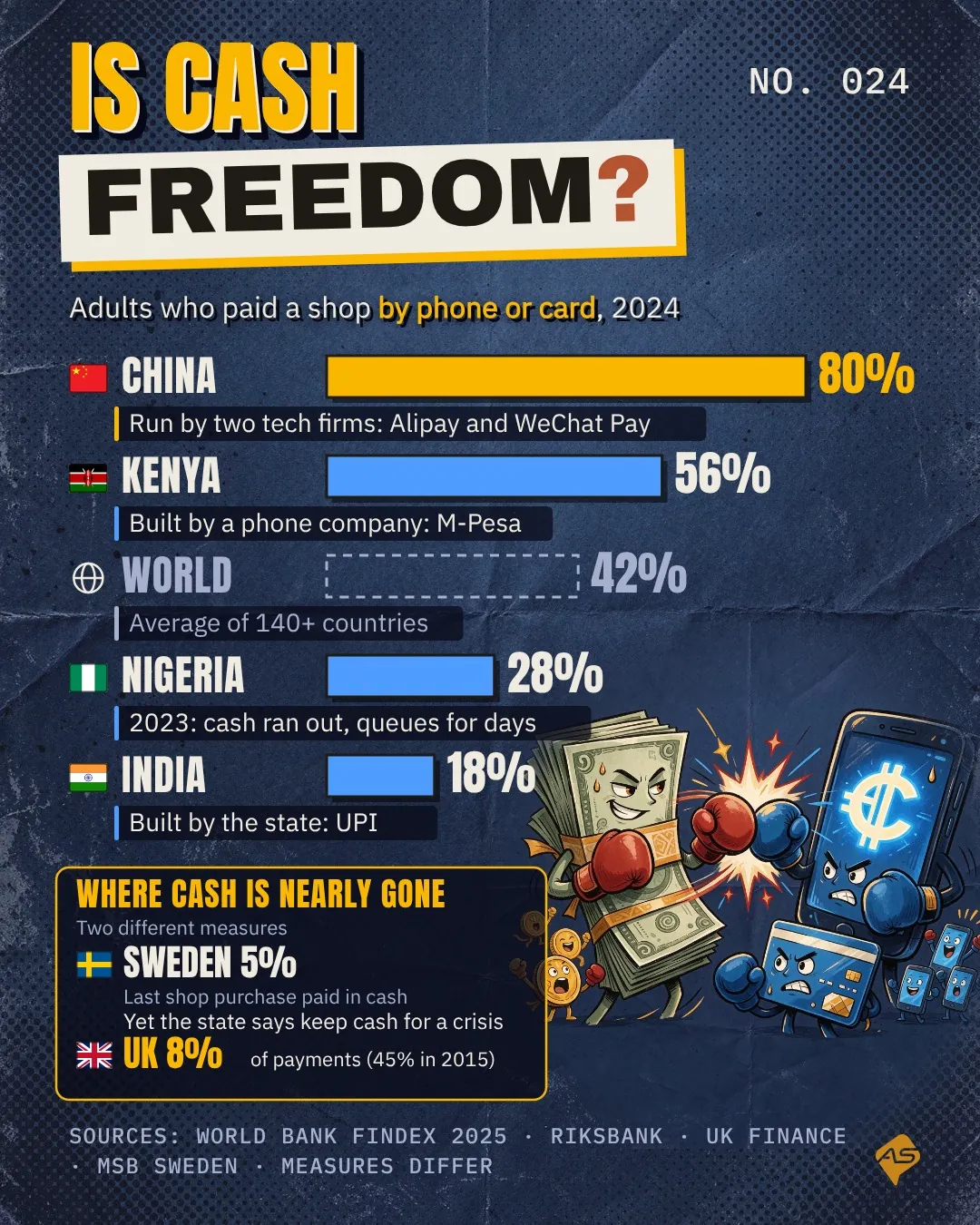
In 2024, 80% of adults in China paid a shop by phone or card, against a world average of 42%. In the UK, cash fell from 45% of payments to 8%.
The numbers behind it
| Country | Figure | Measure |
|---|---|---|
| China | 80% | Adults who paid a shop by phone or card, 2024 |
| Kenya | 56% | Adults who paid a shop by phone or card, 2024 |
| World (140+ countries) | 42% | Adults who paid a shop by phone or card, 2024 |
| Nigeria | 28% | Adults who paid a shop by phone or card, 2024 |
| India | 18% | Adults who paid a shop by phone or card, 2024 |
| Sweden | 5% | People whose last shop purchase was paid in cash (Riksbank) |
| United Kingdom | 8% | Share of payments made in cash, 2025, 45% in 2015 (UK Finance) |
Source and method
This chart mixes measures. The bars are one, from the World Bank Global Findex 2025: the share of adults who made a digital payment to a shop in 2024. The box below uses two others: for Sweden, the share of people whose last shop purchase was paid in cash (Riksbank); for the UK, the share of payments made in cash (UK Finance).
- World Bank, Global Findex Database 2025
- Sveriges Riksbank, Payments Report 2026: payment habits in Sweden (opens in a new tab)
- UK Finance, Payment Markets Report for 2025 (press release, 19 August 2026) (opens in a new tab)
- MSB, the Swedish Civil Contingencies Agency
What it means
- Who builds the system shapes it: two tech firms in China, a phone company in Kenya, the state in India.
- Sweden is almost cashless, and still tells households to keep cash for a crisis.
- Freedom to pay in cash, or freedom to leave it behind: the sequel to No. 005 leaves the question open.
Was this useful?