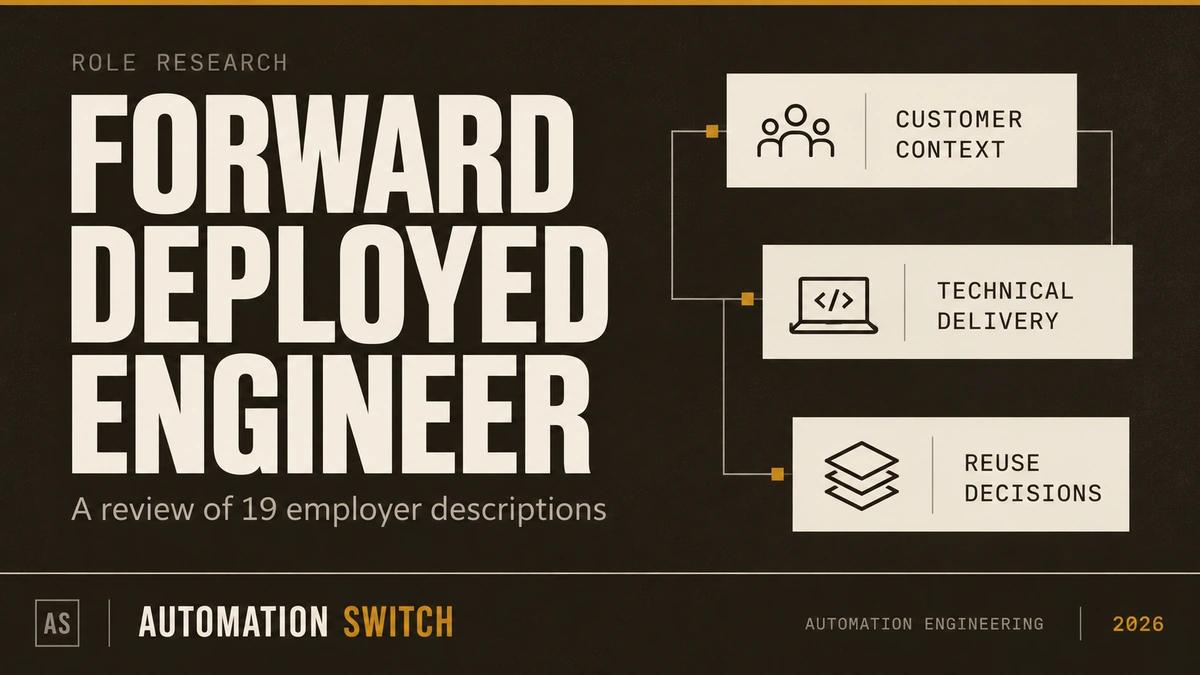
If you are applying for, hiring for or designing a Forward Deployed Engineer (FDE) role, compare ownership and deliverables before comparing titles. Our review of 19 employer descriptions found different responsibilities under the FDE label, and production engineering under adjacent titles.
The useful questions are what the person must deliver, which decisions they control, who maintains the result and what becomes reusable. The employer evidence below helps you ask those questions precisely.
What does “forward deployed” mean?
In the employer descriptions reviewed here, forward deployment means putting technical problem-solving close to the people and environment where a solution must work. That can include discovering requirements, writing software, connecting systems, deploying a service and handling operational problems.
Palantir provides an influential reference model. Its architecture documentation describes a feedback loop between engineers working near users and teams developing the core platform. This describes Palantir’s approach; the employer examples below show how responsibilities vary. Palantir’s Architecture Center
The customer may also be internal. Warner Music Group’s FDE description focuses on business stakeholders across labels and functions. Tesla’s focuses on factory operations, where engineers connect software and AI to production systems. Warner Music Group, Tesla
How we reviewed the roles
We reviewed 19 distinct FDE-family descriptions from 19 employers, plus three adjacent-role descriptions, retrieved on 6 October 2026. We used public English-language employer career pages and employer-controlled applicant tracking systems.
25 selected role URLs → 22 readable descriptions → 19 FDE-family roles and three adjacent roles. Three URLs were excluded because full role text could not be retrieved. Discovered location variants and mirrors were not added as independent observations.
The FDE family includes Forward Deployed Software Engineer and titles with seniority or domain qualifiers. We recorded the actual title, working context, responsibilities, requested experience and source. “Not stated” means the retrieved description does not establish a responsibility; it does not mean the job excludes it.
This is a purposive first edition, not a representative labour-market survey. A healthcare-focused search contributed several records, and the sources are concentrated in US roles and technology employers. Sources were reviewed by one AI-assisted research process without independent coding. The table below makes the selected records inspectable. A readable posting is not confirmation that the vacancy is still open.
Download the reviewed role dataset
Read the research methods and data guide for inclusion rules, exclusions and coding limits. The dataset records advertised work at retrieval, not verified day-to-day practice or a live vacancy feed.
What employers ask FDEs to deliver
Customer delivery can include work before and after the sale
Apollo Research’s role spans technical evaluations, deployment, integration and ongoing support for its security product. It also asks the engineer to decide which customer requests should become product capabilities. Apollo Research
Handoff describes technical ownership of enterprise construction accounts from pilot criteria through integration and ongoing support, while an account manager owns the business relationship. Exa goes further commercially: its description includes outbound prospecting, production integration and closing deals. These are different accountabilities under the same role family. Handoff, Exa
Ask who owns the technical decision, the commercial relationship and the live service. Agree that division explicitly when one person covers several responsibilities.
The deliverable changes with the operating environment
Higharc’s role centres on turning homebuilder plans into structured, searchable data. TRM Labs describes deployment in national-security environments, including restricted infrastructure. Dexterity combines robotics, field commissioning and system performance. Higharc, TRM Labs, Dexterity
Appen provides another useful boundary case: the advertised responsibility centres on delivered AI datasets and quality criteria, with engineering partnerships for pipelines. It lists Python and SQL proficiency as a plus. A definition that requires every FDE to build the same kind of full-stack application would miss this record. Appen
Reusable work is a concrete deliverable
OpenAI asks FDEs to codify working patterns into tools and playbooks. Protege describes turning customer-specific solutions into reusable platform capability. Qualified Health names reusable data components and integration patterns. These are different ways to make learning from one engagement useful to the next. OpenAI, Protege, Qualified Health
Reuse needs a decision. A customer-specific rule may belong in configuration. A repeated integration may justify a shared module. A product gap may need a roadmap decision and a named maintenance owner.
Entry routes vary
Palantir and Netic explicitly advertise new-graduate FDE positions. Commure’s reviewed description asks for at least one year of relevant professional experience. Other records ask for more substantial production backgrounds. In this sample, FDE entry routes span new-graduate and experienced-hire positions. Palantir, Netic, Commure
A new-graduate listing can still ask for strong engineering evidence. Use the posting’s requirements and assessment process to judge the expected level of engineering experience.
FDE versus solutions, implementation and customer engineering
The table compares four specific descriptions. “Not stated” preserves uncertainty.
| Dimension | FDE: Apollo Research | Solutions Engineer: LangChain | Implementation Engineer: Roboflow | Customer Engineer: OpenRouter |
|---|---|---|---|---|
| Starting point | Technical evaluation and customer deployment | Discovery and technical evaluation | Customer solution delivery and adoption | Enterprise technical discovery |
| Main technical output | Integrations, deployment and customer capabilities | Proofs of concept and co-built production agents | Custom computer-vision solutions | Demonstrations and solution architecture |
| Production responsibility | Rollout and ongoing support | Help customers deploy and operate | Deployment and post-deployment support | Ongoing production ownership not stated |
| Commercial involvement | Pre-sales evaluations | Technical win and expansion conversations | Collaboration with sales and support for customer wins | Sales-cycle support through close |
| Reusable contribution | Deployment tooling and product decisions | Reusable examples and field feedback | Shared artefacts and documentation | Product and roadmap feedback |
| Boundary to clarify | Bespoke work versus core product | Co-building versus separately scoped professional services | Delivery scope and ongoing support | Handover from evaluation to implementation |
Sources: Apollo Research, LangChain, Roboflow, OpenRouter.
LangChain explicitly distinguishes its Solutions Engineer role from separate professional-services delivery roles, even while asking the Solutions Engineer to co-build production agents. That makes a simple “solutions equals demos, FDE equals production” split unreliable.
Before accepting or advertising a role, establish who approves scope, who can change shared systems, who handles incidents, and who maintains customer-specific code.
What the findings mean for role design
This analytical model brings together the delivery, operation and reuse responsibilities described above. The recurring decision is how to turn a local problem into a working result, then decide what should remain customer-specific and what should become shared capability.
Baseten engineer Het Trivedi offers a first-person account of customer-facing model and deployment work. The account adds a practitioner’s perspective to the employer descriptions. Trivedi’s account
For candidates
Show one bounded delivery: the user’s problem, engineering choices, validation, failure handling and handover. Explain what became reusable and what remained specific to that user. Match the evidence to the posting; robotics commissioning and AI application deployment demand different depth.
For hiring managers
Define the deliverable, decision authority and maintenance owner before choosing the title. Ask candidates why they configured, coded, generalised, deferred or declined a request, and how they assessed the result. Assess those capabilities through examples of delivery, decision-making and maintenance.
Download the role and deployment worksheet to record scope, ownership, reuse and success criteria.
The reviewed FDE descriptions
Each link identifies the employer record used in this edition. The focus column is our concise coding of the advertised work.
- Apollo Research: Security-product evaluation, deployment and support.
- TRM Labs: National-security deployment and integration.
- Higharc: Structured homebuilder-plan data and tools.
- Handoff: Enterprise construction integrations and support.
- OpenAI: Customer AI deployment and reusable patterns.
- Palantir: New-graduate customer software delivery.
- Assort Health: Health-system integrations and agent workflows.
- Protege: Healthcare-data integration and reusable capability.
- Commure: Customer deployment and integration.
- Hippocratic AI: Healthcare AI integration and production operation.
- Qualified Health: Healthcare ETL, validation and deployment.
- Tandem Health: Clinical-product integration and rollout improvement.
- Dexterity: Robotics field deployment and performance.
- Warner Music Group: Internal data and AI solutions.
- Baseten: Customer AI services across the deployment lifecycle.
- Exa: API integration and commercial ownership.
- Netic: New-graduate AI-agent delivery.
- Tesla: Factory software and AI deployment.
- Appen: AI-data quality, delivery and validation.