

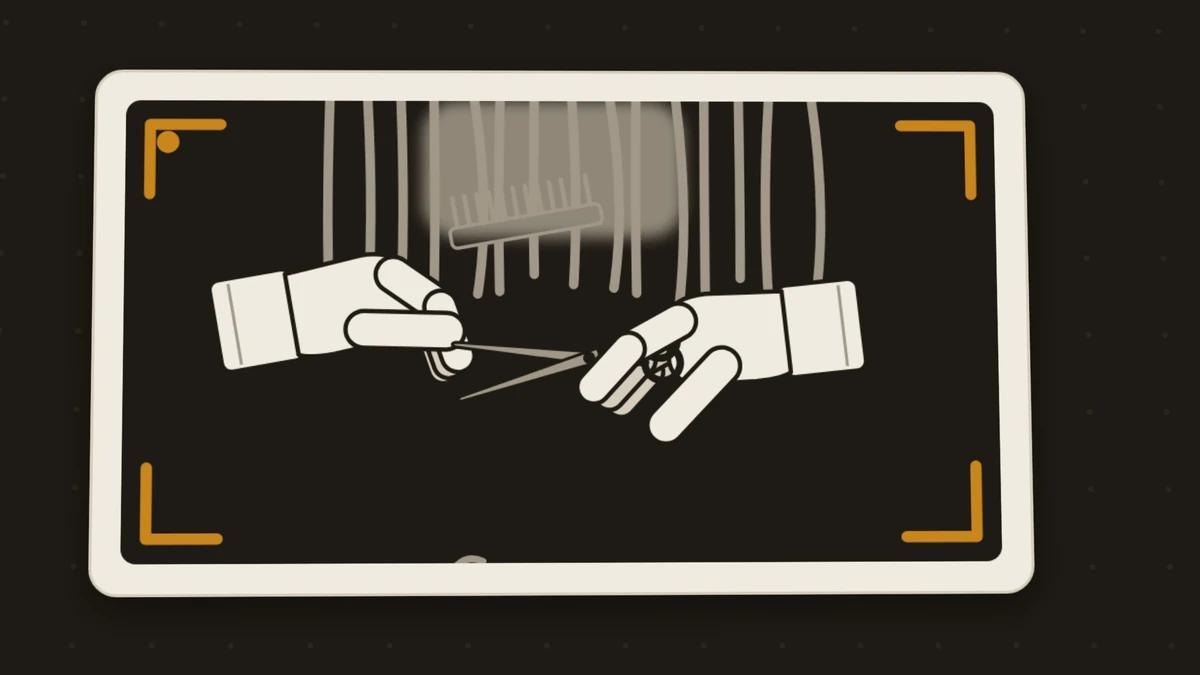
Mohammed Ashim, a barber in Bengaluru who spoke to BBC News, cuts his customers' hair with a small camera strapped to his forehead. The camera records his hands and fingers; the customer's face is blurred out. He wears it for five or six hours a day, and he has learned the rules: hands cleanly inside the frame, lighting sharp, head steady. [1]
Someone is paying for this footage. Why would anyone buy a video of a haircut?
The answer shows where the next wave of AI gets its data, and where the value in that data is moving. If you are building your tech skills, that second part is the one to watch.
We started with Priti Gupta's BBC News report and followed the footage from there: to the research labs, and to the data companies that pay people to film their work. Most of the figures below are those companies' own accounts, so each one carries the name of whoever reported it.
This article is the written companion to the Automation Switch film The Workers Filming Their Hands to Train Robots, which follows the same footage in seven minutes.
What is a haircut video worth to an AI lab?
The barber's footage goes to a local data company, which sells it on to technology companies and research labs. They use it to train physical AI: artificial intelligence that controls robots in the real world. [1]
Chatbots learned to write by reading text the world had already written. A robot has to learn something new: how to use its hands. How to hold the scissors. How hard to grip. When to let go.
Manish Agarwal, founder of Humyn Labs, a company that collects and processes this kind of data, describes the lesson in physical terms. A robot needs signals about limbs, fingers, wrists and force. His example is grip: the right force to hold a plastic bottle so it keeps its shape, compared with the right force for a steel glass. He argues that robots for the real world need more than simulation to learn it. [1]
That lesson has to come from somewhere, and the natural place to look is video of people's hands at work.
Where does a robot learn to use its hands?
Video of hands at work, filmed through the worker's own eyes, is rare. Agarwal says this data has to be captured from scratch, in the real world. [1]
The best-known archive shows the size of the gap. Meta, the company behind Facebook and Instagram, led a research project with university partners called Ego4D, first published in 2021. The paper's title, "Around the World in 3,000 Hours of Egocentric Video", uses the round figure of its first release, which the authors call Ego4D-3K. Its abstract gives the full count: 3,670 hours of first-person video, recorded by 931 people in 74 locations across nine countries. [3]
It is a landmark. Played round the clock, by our arithmetic, it would run for about five months. Set beside the written internet that trained the chatbots, it is one small shelf in a very large library.
The other routes each carry a cost. CNN reported that teleoperation, where a person steers a real robot by remote control while it records, needs a lot of expensive hardware, and that simulation is generally less effective for interactions with physical objects. Filming a person costs a recording device and their wages. [2]
That makes human video the affordable route. The next test is whether more of it makes a better robot.
Does more footage make a better robot?
NVIDIA, the chipmaker, tested exactly that with researchers at UC Berkeley and the University of Maryland. In a paper posted in February 2026, called EgoScale, they pre-trained a robot on 20,854 hours of first-person human video, then trained it on five hand tasks using a robot hand with 22 degrees of freedom: rolling a shirt, sorting cards, moving fruit with tongs, unscrewing a bottle cap and transferring liquid with a syringe. Their best version also had a short middle stage of training on human and robot recordings matched to each other. Across the five tasks, it succeeded far more often than the same robot trained from scratch. [4]
An absolute gain in percentage points, measured against a version trained from scratch with no human-video pre-training (the paper's Figure 4).
That is one lab's result, on its own tasks, measured over a small number of trials per task and against its own baseline. It points clearly in one direction. The pre-training set alone is more than five times the size of Ego4D, and it paid off in the robot's hands.
The market has moved accordingly. Micro1, a company in Palo Alto, California, says about 4,000 contributors in 71 countries send it more than 160,000 hours of video a month. [2] On its own figures, that is roughly 44 Ego4D archives arriving every month. Its vice president of robotics data, Arian Sadeghi, told CNN the need is far larger: "You need probably billions of hours." [2]
Billions of hours of hands at work. Who films all of that?
Who films billions of hours of hands at work?
The BBC reports that hundreds of thousands of people around the world are now paid to record their activities. [1] The work they film is wide. Mohammed Arman, a tailor in Bengaluru with ten years' experience, records his stitching and cutting. Jolly Arifur, a science teacher, records her housework for a few hours a day: scrubbing, cooking, sweeping, folding laundry. Both told their stories to the BBC. [1]
Shahil Baig is co-founder of Rashdan Technologies, another company that collects and processes this data. He lists what clients ask for: industrial tasks, agriculture, household chores and small-business crafts such as pottery, garment-making and embroidery. "We go wherever the task is," he told the BBC. [1]
Humyn Labs, with bases in Bengaluru and San Francisco, says it has 96,000 data collectors across Latin America and Southeast Asia. [1]
The method is consistent from company to company. The camera sits roughly where the eyes are, on the head or chest, because robots and wearable assistants see from inside the task, and that viewpoint matters more than production polish. Each task is repeated with small variations, so a model learns what stays constant. Every clip is reviewed against a brief, the written instructions for what to film and how, and sent back for faces in frame, the wrong angle, poor lighting or missing steps. [5]
Pay depends heavily on where the work happens, and each figure belongs to whoever reported it. Rashdan says it pays $5 to $10 for eight to ten hours of recorded work. [1] The teacher says she earns $2 to $3 an hour, recording three to five hours a day, and calls it an extra source of income on top of teaching. [1] Micro1 says its contributors earn $5 to $20 an hour depending on region, with US rates up to three times those in Vietnam or India. [2] The barber says what keeps him excited is "the feeling of doing something this futuristic". [1]
What clients ask of these collectors keeps growing.
What happens when clients ask for more?
Baig says clients now want four to six cameras rigged around a person's head, to cover the whole scene as well as the hands. Asking someone to wear one small camera is one conversation, he says. Asking them to wear what is effectively a five-camera headset is a harder one, so Rashdan pays more for that tier. [1] He says faces are blurred, and the footage clients receive is stripped of anything that identifies a worker. [1]
More cameras raise the bar on quality, and quality is already the hard part. Objectways, which built datasets for self-driving cars and virtual assistants before moving into robotics data, says only about half of the footage submitted to it has been usable. [2]
Then comes the question any collector could fairly ask: is this footage teaching machines to do the same jobs? Bino Paul, a senior professor at the School of Management and Labour Studies at the Tata Institute of Social Sciences in Mumbai, says it is too early to tell. AI may become a useful tool for some workers and automate the work of others. His concern is timing: "By the time workers realise what they have participated in, things may have gone too far." He wants governments to regulate AI. [1]
The tailor weighs it differently. "For me, it's simple. This is survival," he told the BBC. It is the same work he already does, and now it pays him a little more. [1]
Both views stand, and the jobs question stays open. The value question has a clearer answer, and it starts after the camera.
Where does the value in all this footage sit?
Follow the footage one step past the camera. At Humyn Labs, thousands of hours of video arrive from collectors. The company filters them, selects the most useful, labels them so the AI knows what it is looking at, and packages them in a format clients can use. [1]
Now set the companies' own accounts side by side. Micro1 reports more than 160,000 hours arriving every month. [2] Objectways reports that about half of what arrives has been usable. [2] Humyn Labs committed $20 million in April 2026 to expand data collection and validation, the checking step, across India, Southeast Asia and Latin America. [6][7] Mindrift, another collector, describes every submission being reviewed against a brief before it is accepted. [5]
Agarwal reads the trend directly. He describes India's current role in the industry as largely a supplier of raw footage, and argues that the value of that work will erode as more collectors compete. [1] His answer is to move up the value chain: "from recording raw video to owning the pipeline that turns that video into something usable", and on to setting the standards for what counts as high-quality training data. [1]
Read together, these accounts point the same way. Footage is becoming plentiful. The value is moving to the work that turns it into data a robot can learn from: the brief that shapes the capture, the filter that keeps what teaches, the labels that give each clip meaning, the checks that make it trustworthy, and the standard that defines good.
How can you start building the part that makes footage usable?
Every data company in this story runs the same jobs after the camera. Someone writes the capture brief: what to film, from where, and how many times. Someone designs the labels, so every clip means the same thing to the machine. Someone checks the quality against the brief. And someone sets the standard for what is good enough to train on. [1][5]
You can practise all four this week with a phone and an hour.
- 01Pick one task you do with your hands
Folding a shirt works well; rolling a shirt was one of the five tasks in NVIDIA's EgoScale research.
- 02Write the capture brief
Camera at eye height, hands inside the frame, lighting sharp, every step in order. It is the same brief the barber in Bengaluru works to.
- 03Film the task five times
Change one small thing each time: the shirt, the surface, the speed. Collectors repeat each task with small variations so a model learns what stays constant.
- 04Set the quality bar
Decide what makes a clip usable, then set aside any clip that loses the hands or skips a step.
- 05Label every usable clip
Step by step, write down what the hands are doing and when, using the same words for the same action every time.
Now look at what is on your table. A brief someone else could follow. A quality bar that kept some clips and set others aside. A labelled set where every step means the same thing. You have designed a small data system, and each part of it is one of the jobs the companies in this story describe as the work after the camera.
Go back to the barber in Bengaluru, hands inside the frame, head steady. His footage is where the pipeline starts, and you have just built the part that comes next. Run it again with a second task. Tighten the brief. Hand your labels to a friend and see whether they read every clip the same way you do: that agreement is the beginning of a standard. Each round builds the skills that turn footage into something a robot can learn from.
Build the tech skills and systems for the future you want.