

No. 014 · 18 November 2026
AI prompts: how much energy does one use?
The energy one AI text prompt uses, compared with a kettle, a phone charge and a year on a UK electricity bill.
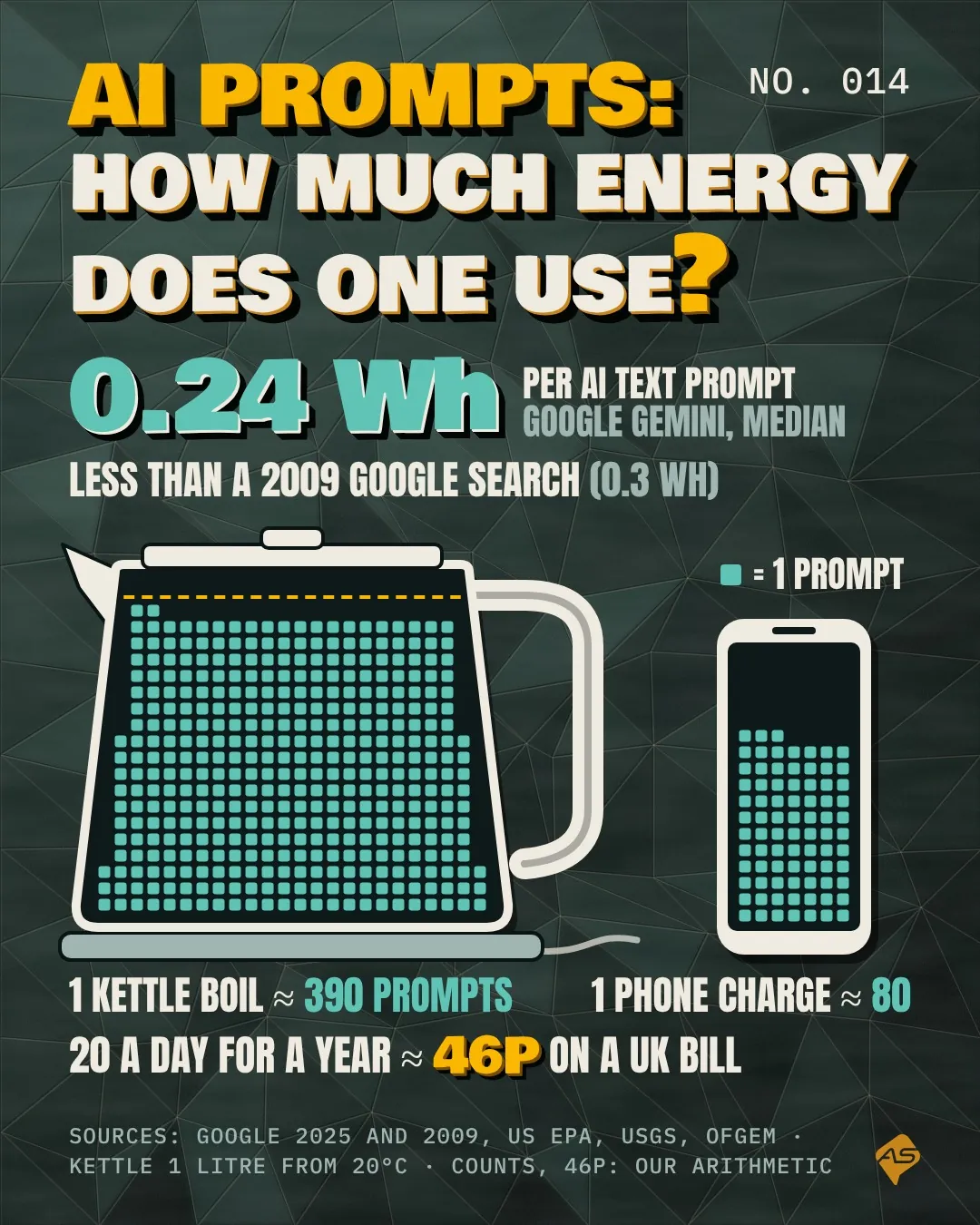
A typical Gemini text prompt uses about 0.24 Wh, less than a 2009 Google search. A kettle boil is about 390 prompts; 20 a day for a year, about 46p.
The numbers behind it
| Task | Energy | In Gemini prompts |
|---|---|---|
| One Gemini text prompt (median) | 0.24 Wh | 1 |
| One Google search, 2009 | 0.3 Wh | about 1.25 |
| Boiling 1 litre of water from 20°C | 93 Wh | about 390 |
| One smartphone charge | 19 Wh | about 80 |
| 20 prompts a day for a year | 1.75 kWh | about 46p on a UK bill |
Source and method
Google’s own measurement for the median Gemini Apps text prompt (2025), with a published method; it covers serving the answer, not training the model. The kettle is the physics minimum for 1 litre from 20°C. Prompt counts and the 46p (at 26.32p per kWh) are our arithmetic.
- Google Cloud, Measuring the environmental impact of AI inference (21 August 2025) (opens in a new tab)
- Elsworth et al. (Google), arXiv 2508.15734 (opens in a new tab)
- Google, Powering a Google search (11 January 2009) (opens in a new tab)
- US EPA, Greenhouse Gas Equivalencies Calculator references (opens in a new tab)
- USGS, Specific heat capacity and water (opens in a new tab)
- Ofgem, energy price cap, 1 October to 31 December 2026 (opens in a new tab)
What it means
- One text prompt is a small amount of energy next to everyday appliances.
- Long answers, reasoning modes, images and video use more than a plain text prompt.
- Google reports its energy per prompt fell 33 times in a year.
Was this useful?