No. 012 · 7 November 2026
Where do AI coding tokens go?
How AI coding agents’ tokens split between re-reading context and writing new code, and how that shows up on the bill.
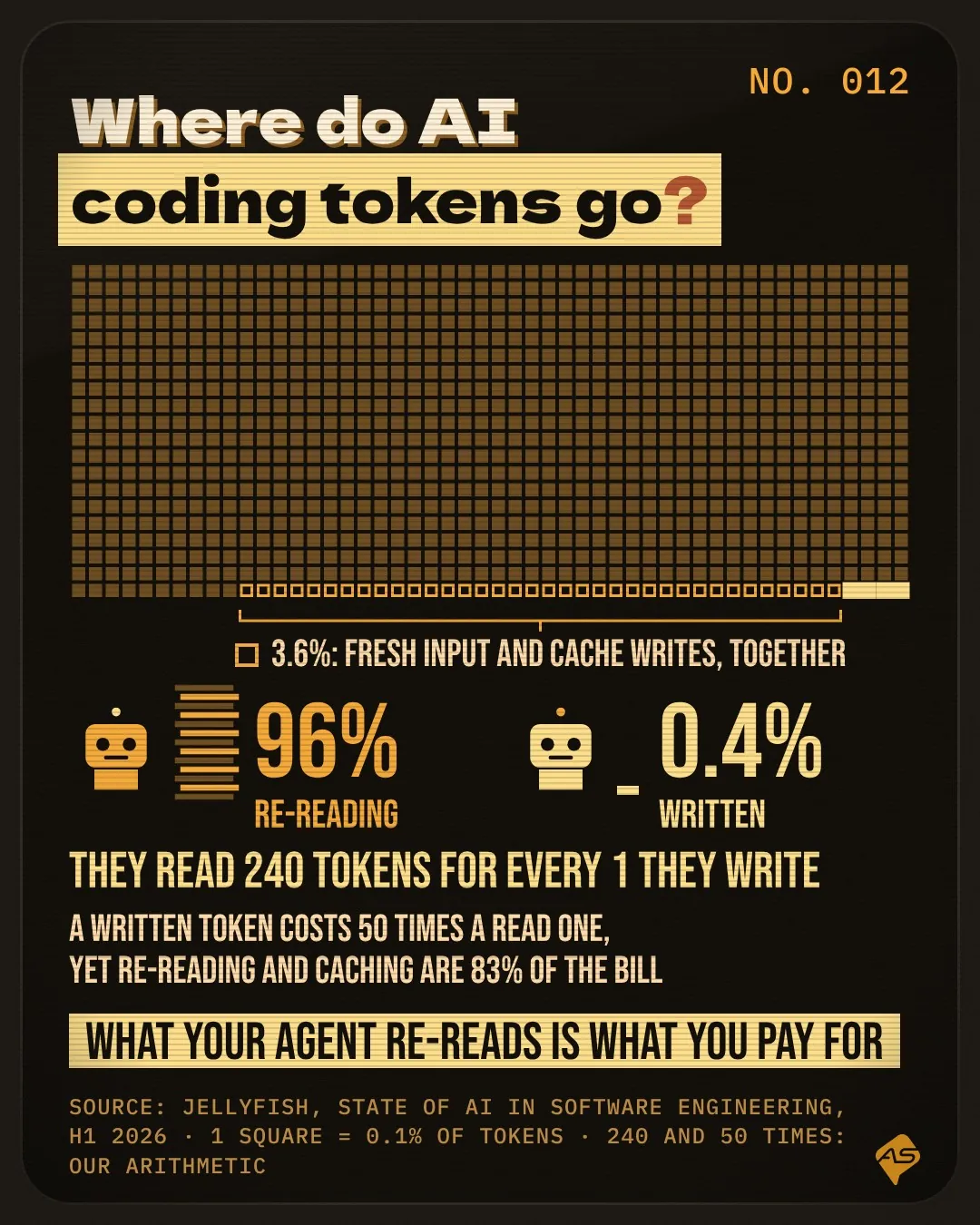
AI coding agents spend 96% of tokens re-reading and 0.4% writing code: 240 read for every 1 written. Re-reading and caching are 83% of the bill.
The numbers behind it
| Measure | Figure |
|---|---|
| Tokens spent re-reading (cache reads) | 96% |
| Tokens for fresh input and cache writes | 3.6% |
| Tokens written as output | 0.4% |
| Bill for cache reads and writes | about 83% |
| Bill for output | 16% |
| Median user’s monthly cost, August 2025 | about $5 |
| Median user’s monthly cost, May 2026 | $81 |
Source and method
Jellyfish data for the first half of 2026, rounded as published. “240 for every 1” and “50 times” are our arithmetic; the 3.6% is what remains after re-reading and output, as Jellyfish does not split it.
What it means
- Context drives cost: what your agent re-reads is what you pay for.
- Keeping an agent’s context small and focused is the direct way to cut the bill.
- The median user’s monthly cost rose from about $5 to $81 in nine months.
Was this useful?