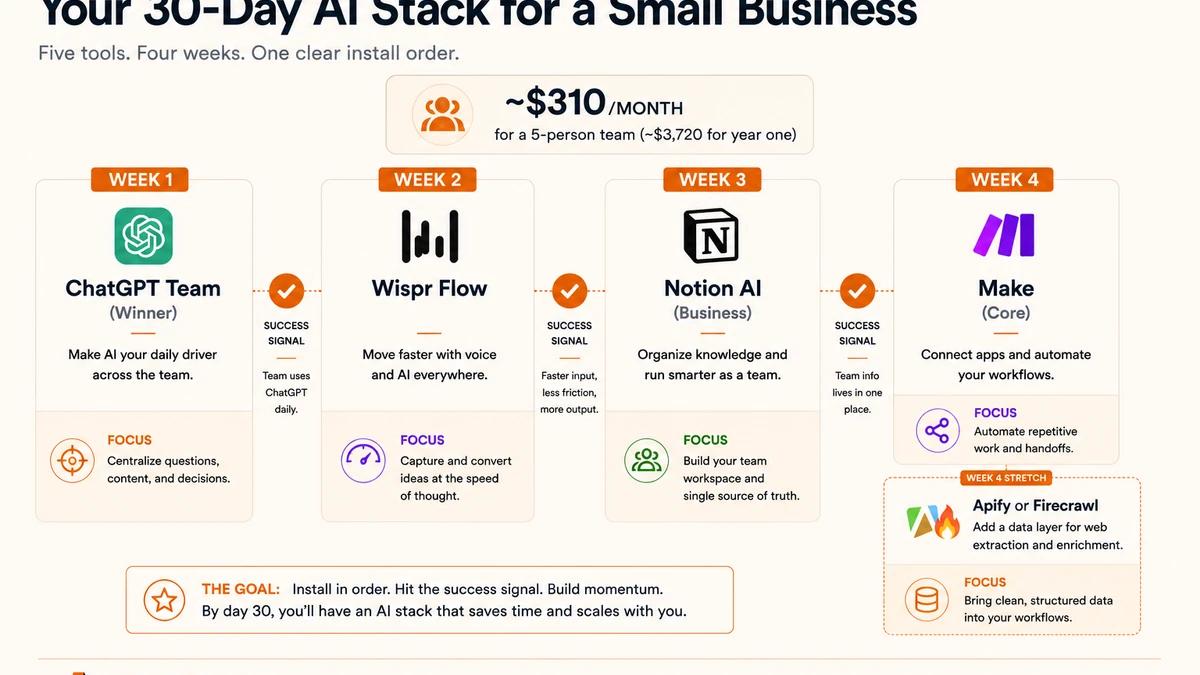
A small business operator with zero AI experience reads ten "best AI tools" articles, ends up with eighteen browser tabs, and installs nothing. The SERP optimises for tool count. The operator needs install order. This article delivers the install order, indexed by the calendar, with a stack cost around $310 a month for a five-person team.
The verdict, in the first sixty seconds: ChatGPT Team is the top pick for week one as the daily AI driver. Wispr Flow follows in week two for input speed. Notion AI lands in week three as the team workspace. Make arrives in week four as the cross-app glue. Apify or Firecrawl closes the month as the data prep layer. Five tools, in that order, gated on a success signal before the next one ships.
This article is the entry-level companion piece. The reader who already runs five AI tools belongs in the consolidation guide. The reader opening ChatGPT for the first time belongs here.
Prices in this article are USD annual-billed monthly equivalents from each vendor pricing page at last review. Live pricing may have changed since publication. Regional pricing, currency conversion, post-tax rates, promotional discounts, and free-tier credits can shift the actual cost shown at signup. Confirm against the vendor pricing page before purchasing.
How we picked these 5 tools
Most "best AI tools" articles rank by feature score. This one ranks by the calendar. Each tool earns its place by a single concrete job-to-be-done, and each tool is gated on a success signal before the next install. Skip the sequence and adoption stalls inside the third week, when a five-person team finds itself paying for tools no one is using.
The picking method is three filters in order:
- One job-to-be-done per tool. ChatGPT Team replaces drafting and brainstorming. Wispr Flow replaces typing the long-form drafts. Notion AI replaces "where does that live". Make replaces copy-paste between apps. Apify or Firecrawl replaces "I will research it manually".
- Onboarding under a half-day for a non-technical operator. Week-one tools are the ones a non-technical operator installs alone. Calling in technical help means the tool belongs later in the sequence.
- A success signal that gates the next install. Each tool's success signal must clear before the next install ships. Adding tool number two before tool number one earns its keep is the brain-fry mistake.
Year-one cost for a five-person team running this stack lands around $3,720, or roughly $310 a month. ChatGPT Team at $25 per user annual, Wispr Flow at $144 per user per year, Notion Business at $20 per user annual, Make Core at $9 a month annual-billed, and Firecrawl Hobby at $16 a month. Below that ceiling the recommendations stand. Above it, the team is over-tooled and the right move is consolidation rather than expansion.
$1,500 ChatGPT Team + $720 Wispr Flow + $1,200 Notion Business + $108 Make Core + $192 Firecrawl Hobby. Roughly $310 a month at the ceiling.
1. ChatGPT Team: the daily AI driver (Week 1)
Pricing: $25 per user per month, billed annually.
Best for: any non-technical operator who needs a sidekick the team will actually use. ChatGPT Team bundles voice, image, search, and the broadest plugin ecosystem in one subscription a small business can navigate without choosing between modalities.
ChatGPT Team is the week-one anchor because the daily AI habit forms here. Sign up the entire team and make ChatGPT Team the default AI surface for the first thirty days. The success signal at the end of week one is ChatGPT outputs landing in real work: Slack threads, email drafts, brief write-ups, structured reasoning notes. The team treats ChatGPT as a default tool, not as something to remember to use.
Heavy long-form writers can run Claude Pro alongside from day one. Automation Switch runs both daily: ChatGPT Team for breadth-of-modality (voice, image, search inside a single conversation), Claude Pro for the heavy long-form work and the longer-running coding sessions. The article positions ChatGPT Team as the install-sequence anchor because non-technical teams need one default surface to build the habit; Claude Pro earns its place alongside for any team already writing long-form.
API and MCP: REST API with bearer auth and tier-based rate limits. ChatGPT became a first-class MCP host through the Apps SDK and Developer Mode connectors, which means every other MCP-equipped tool in this stack plugs straight into ChatGPT Team without custom glue.
- Broadest modality coverage in one subscription (voice, image, search, plugins)
- Onboards a non-technical operator in under thirty minutes
- Workspace controls keep team usage governable
- No prompt routing decisions to make on day one
- Claude Pro is the stronger pick for long-form writing; heavy writers run both
- Annual billing is the only path to the $25 per user price
- Workspace admin features sit behind the more expensive Enterprise tier
- Plugin quality is uneven; the team has to learn which ones earn their keep
Score: 5 of 5 for week-one daily driver.
2. Wispr Flow: input speed (Week 2)
Pricing: $144 per user per year (Pro plan).
Best for: writing-heavy operators. Wispr Flow compresses every first draft from typed sentences into spoken thoughts. Sales emails, support replies, internal updates, and Slack messages all get the same treatment.
Wispr Flow is the second install because input is the bottleneck the daily AI habit hits in week two. A team running ChatGPT Team five times a day still types every prompt by hand, and the time saved on output gets spent on input. Wispr Flow moves a 300-word draft from fifteen minutes typed to under three minutes dictated, and the success signal at the end of week two is that the team's longest written outputs each day are dictated.
The competitor most operators reach for first is Otter, which records meetings rather than drafting text. The job-to-be-done here is faster input. Wispr Flow has uneven Trustpilot reviews and ships with screenshot context on by default; regulated teams should turn on Privacy Mode before rolling it out.
API and MCP: closed-beta API only, gated behind enterprise contact, with no known MCP server. The intentional gating means programmatic dictation pipelines stay blocked unless the team has an enterprise relationship, so Wispr Flow stays a UX-layer tool inside the AI adoption stack.
Wispr Flow pricing tiers
- ✓2,000 words per week
- ✓Cross-application desktop dictation
Recommended for writing-heavy operators
- ✓Unlimited words
- ✓$144 annual or $15 monthly
- ✓Privacy Mode for screenshot context
- ✓Shared seats and admin controls
- ✓Per-seat annual billing
- Five-times faster first drafts on long-form writing
- Cross-application: works inside Gmail, Slack, Notion, ChatGPT, and any text field
- Pays for itself in the first week if the operator writes more than 1,000 words a day
- Free 14-day trial reduces the install risk to zero
- Trustpilot rating sits at 2.7 of 5 in current public reviews
- Screenshot context is on by default; regulated teams need to enable Privacy Mode
- Annual billing per seat at $144 is the only sensible plan for a team
- Quality drops in noisy environments without a decent microphone
Score: 4 of 5 for input-speed lift; 3 of 5 for privacy posture.
3. Notion AI (Notion Business): the team workspace (Week 3)
Pricing: $20 per user per month, billed annually (Notion Business).
Best for: teams already in Notion who want AI inside the docs they live in. Notion AI sits inside the workspace where the team writes notes, builds SOPs, and tracks projects, so the AI assistant answers from the team's own knowledge rather than the open web.
Notion AI is the third install because by week three the team has output worth searching. ChatGPT Team has produced drafts. Wispr Flow has produced volume. Notion AI turns the pile of week-one and week-two artefacts into a queryable workspace. The success signal at the end of week three is that the answer to "where does that live" is "in Notion" rather than "in someone's Slack DMs".
Notion AI now ships bundled into the Business plan; the standalone add-on was retired in May 2025. Teams already on Notion Plus need to upgrade. The migration is light: pick the five most-used team docs, move them in first, and run "Ask Notion" against each one inside the first forty-eight hours.
API and MCP: REST API with internal integration tokens or OAuth 2.0, averaging three requests a second per integration. Notion ships an official hosted MCP server (makenotion/notion-mcp-server) plus community wrappers, which makes it the cleanest agent-ready knowledge layer in the AI adoption stack.
- AI runs against the team's own knowledge, not the open web
- Bundled with Notion Business, so one bill replaces two
- Search, summarisation, and writing assistance share the same workspace surface
- Migration friction is minimal for any team already running Notion
- Standalone Notion AI add-on is discontinued, forcing the Business upgrade
- Teams not already in Notion face a workspace migration before the AI earns its keep
- AI quality is workspace-dependent: thin documentation produces thin answers
- The $20 per user annual price doubles a team's Notion bill at the upgrade boundary
Score: 4 of 5 for team-workspace AI when Notion is already the system of record.
4. Make (with AI features): cross-app glue (Week 4)
Pricing: $9 per month for 10,000 operations on the Core plan, billed annually.
Best for: ops teams who need AI inside workflow automation. Make connects the team's SaaS apps to each other and lets ChatGPT, Notion AI, and Wispr Flow outputs flow into structured workflows.
Make is the fourth install because by week four the team has habits worth automating. The CRM gets new leads, the inbox gets new replies, and the Notion workspace gets new docs. Make wires those events together so the team stops copy-pasting between five tools. The success signal at the end of week four is at least three workflows the team used to run by hand are now running on Make rails.
The competitor most operators reach for first is Zapier. Make is three to five times cheaper at the operations counts a small business actually generates, and the visual scenario builder is friendlier for non-technical operators. Zapier wins later when the team needs the long tail of integrations or tighter AI-agent features. Build three scenarios the first week, no more: a form-fill into the CRM, a Slack notification on a new sale, and an AI-generated summary into Notion.
Make affiliate program is pending approval at Automation Switch at time of publication. The recommendation stands on the editorial merits; any link to Make routes through the Make site directly until affiliate status flips to active.
API and MCP: REST API with API tokens or OAuth, capped at 240 requests per minute on Teams. Make ships a cloud-hosted MCP server over Streamable HTTP and SSE that turns any active scenario into an agent-callable tool, so the same workflows that glue the SaaS stack also become tools ChatGPT or Claude can invoke directly.
Make pricing tiers
- ✓1,000 credits per month
- ✓2 active scenarios
Recommended for week-four cross-app glue
- ✓10,000 credits per month
- ✓Unlimited active scenarios
- ✓$108 annual
- ✓10,000 credits per month
- ✓Priority execution
- ✓Full-text search
- Three to five times cheaper than Zapier at small-business operation counts
- Visual scenario builder is friendlier for non-technical operators
- Native AI features inside scenarios, so ChatGPT and Notion AI outputs become workflow inputs
- Pay-per-operation pricing keeps costs predictable as automation grows
- Long-tail integrations are weaker than Zapier for niche SaaS apps
- Operations counter requires monitoring at scale to avoid plan jumps
- The visual builder hides errors that a code-first tool would surface immediately
- AI-agent feature set lags Zapier and n8n on the bleeding edge
Score: 4 of 5 for cross-app glue at small-business pricing.
5. Apify or Firecrawl: the data prep layer (Week 4 stretch)
Pricing: Apify free tier ($5 monthly credits, no card), Starter $29 a month. Firecrawl free 500 credits, Hobby $16 a month.
Best for: data-prep heavy use cases. Apify is the right pick when the team needs scheduled scraping from social platforms, e-commerce sites, or maps. Firecrawl is the right pick when the team needs LLM-ready markdown from arbitrary websites for ChatGPT or Notion AI to read.
Pick one. The shape of the data the team needs decides which. Apify gives structured datasets from many specific sources via its Actor library. Firecrawl gives clean markdown from any URL ready for an LLM to read. Both have free tiers worth installing first; only buy the paid plan after the free tier resource ceiling is hit.
The success signal at the end of day thirty is at least one ChatGPT, Notion AI, or Make workflow is consuming fresh external data the team did not have to copy-paste. If neither tool earns its keep against that signal by day thirty, cancel both and revisit in month two.
API and MCP: both ship REST APIs and official MCP servers. Apify exposes thousands of Actors as dynamic MCP tools at mcp.apify.com; Firecrawl publishes firecrawl/firecrawl-mcp-server with full coverage of scrape, search, crawl, map, and extract. Either is plug-and-play as a data prep layer for ChatGPT or Claude.
- Both have free tiers that earn their keep before any spend
- Apify Actor library covers most common scraping targets out of the box
- Firecrawl markdown output is LLM-ready with no parsing layer
- Either tool feeds ChatGPT, Notion AI, and Make scenarios with fresh data
- Apify and Firecrawl are alternatives. Pick one based on data shape
- Scheduled scraping requires baseline care for proxies, retries, and rate limits
- Free tier resource ceilings hit faster than the team expects on production workloads
- The data prep layer pays off only when the other four tools are already running
Score: 4 of 5 for data prep when an upstream AI workflow is already running.
The 5-tool comparison
| Criteria | ChatGPT TeamTop Pick | Wispr Flow | Notion AI Business | Make Core | Apify or Firecrawl |
|---|---|---|---|---|---|
| Install week | Week 1 | Week 2 | Week 3 | Week 4 | Week 4 stretch |
| Job-to-be-done | Daily AI driver | Input speed | Team workspace | Cross-app glue | Data prep layer |
| Price (small team) | $25 per user annual | $144 per user annual | $20 per user annual | $9 a month annual-billed | Free tier first, then $16-$29 |
| Public API | Yes (REST) | Closed beta | Yes (REST) | Yes (REST) | Yes (REST) |
| MCP support | MCP host (consumes) | None known | Official + community | Official hosted | Official + community |
| Onboarding time | Under 30 minutes | Under 30 minutes | Under an hour | Half a day | Half a day |
| Score (1-5) | 5 | 4 | 4 | 4 | 4 |
By day thirty each tool must earn its keep against its specific job-to-be-done. Tools that fall short get cancelled. Adding a sixth tool waits until each of the five is paying for itself.
How to choose: the 30-day install playbook
The five-tool list is a sequence, not a menu. The reader who installs all five on Monday will use none of them by Friday. The reader who installs them in order earns one habit a week and arrives at day thirty with a working AI workflow. Each step gates the next on a real success signal.
- 01Week 1: ChatGPT Team as the team default
Sign up for ChatGPT Team Business at $25 per user annual. Add every team member to the workspace. Make ChatGPT Team the default AI surface for the team. Heavy long-form writers can run Claude Pro alongside from day one; Automation Switch uses both daily. The success signal at end of week one is ChatGPT outputs landing in real work: Slack threads, email drafts, brief write-ups. The team treats ChatGPT as a default tool, not as a curiosity. Reserve for later: Notion AI, plugin connectors, and API keys.
- 02Week 2: Wispr Flow on every laptop
Install the free 14-day trial across every laptop. Pay $144 per user per year at the end of the trial. Set the daily target at one long-form dictated message per person inside Gmail, Slack, or Notion. Read the success signal at end of week two: longest written outputs are dictated, and time-to-draft on a 300-word email drops from fifteen minutes to under three. Reserve for later: meeting transcription, Otter, and cross-app integrations.
- 03Week 3: Notion Business and Ask Notion
Upgrade or create a Notion Business workspace at $20 per user per month annual. Migrate the five most-used team docs first. Set the daily target at two Ask Notion or AI summarisation runs per workday per team member. Read the success signal at end of week three: the team's first answer to "where does that live" is "in Notion". Reserve for later: new templates, second knowledge tool, and full workspace migration.
- 04Week 4: Make and three connected workflows
Sign up for Make Core at $9 a month annual-billed for 10,000 operations. Build three scenarios only: a form-fill into the CRM, a Slack notification on new sales, and an AI summary into Notion. Read the success signal at end of week four: three workflows the team used to run by hand are running on Make rails, with operations under 1,000 per scenario per month. Reserve for later: scenarios beyond the first three, Zapier evaluation, and n8n migration.
- 05Week 4 stretch: Apify or Firecrawl based on data shape
For structured data from social platforms, e-commerce sites, or maps, start with Apify free tier, then Starter at $29 a month if the free tier resource ceiling is hit. For LLM-ready markdown from arbitrary websites, start with Firecrawl Hobby at $16 a month. Read the success signal at end of day thirty: at least one ChatGPT, Notion AI, or Make workflow is consuming fresh external data the team did not have to copy-paste. Run a single tool this week. The second tool ships when its use case is genuinely separate.
How Automation Switch uses this stack
Disclosure that doubles as the editorial standard: every tool in this article is part of day-to-day operations at Automation Switch, used predominantly, occasionally, or for specific tasks. The recommendations are written from inside the workflow, not from an outside review.
- ChatGPT Team is the predominant daily driver across drafting, briefing, and structured reasoning work.
- Wispr Flow is the predominant input layer; the longest written outputs each day are dictated, including most of the prose that lands in articles like this one.
- Notion AI on Notion Business is the system of record for editorial planning, the article production pipeline, and the live status of every workflow.
- Make is the cross-app glue tying Sanity, Notion, Slack, Gmail, and the affiliate tracker into one operational backbone.
- Apify and Firecrawl are both in active rotation: Apify when the data shape needs a purpose-built Actor, Firecrawl when the team needs LLM-ready markdown from any URL.
- Gemini Pro and Google AI Studio sit in the rotation for image generation, structured prompt prototyping, and Google Workspace-native tasks where switching context out of Gmail or Docs would slow the work.
- Claude Pro is the secondary writing tool for the heavy long-form work and the longer-running coding sessions.
Without this stack, scaling Automation Switch to its current cadence of weekly publishing, multi-cluster research, and a live affiliate tracker would be infeasible. The five-tool sequence in this article is the foundation that makes the wider scaling story possible.
What to add in month two (and what to defer to month three)
By the end of month one, the team has the foundation. Month two opens the door to a second wave, picked by use-case rather than calendar.
Add in month two if the use case appears:
- Claude Pro for the heavy long-form writers on the team.
- Gemini Pro (Google AI Pro) for teams already living in Google Workspace, where Gemini sits inside Gmail, Docs, Sheets, and Drive without a context switch. The Veo 3 video model and Nano Banana image model also ship inside the same plan when visual asset generation enters the workflow.
- Google AI Studio for the team member who wants to prototype prompts and structured outputs against Gemini before any API spend lands. The free tier carries enough headroom for a small team to validate a use case before the paid plan ships.
- Otter for meeting transcription, separate from the dictation use case.
- Perplexity Pro for research-heavy roles.
- Buffer for social scheduling once the content workflow is consistent.
- A domain-specific MCP server for Slack, Google Drive, or GitHub once the team is comfortable in ChatGPT Team and Notion AI.
Defer to month three:
- GitHub Copilot or Cursor until the team has developers.
- Midjourney until visual asset generation is a core workflow.
- Enterprise AI platforms; the spend is premature at this team size.
The verdict
Five tools, in this order, in thirty days. Total cost around $310 a month for a five-person team. Each install is gated on a success signal the team can read in week one: ChatGPT outputs landing in real work, longest outputs dictated, Ask Notion twice a workday, three workflows on Make rails, one workflow consuming fresh external data. Below those signals the next install waits. By day thirty the cancel rule decides which tools stay and which leave the stack. Above day thirty, the consolidation guide takes over. The job is sequence, not breadth.
The next move depends on which job-to-be-done in the operator's specific business is the slowest. The Automation Switch audit picks the answer: which of the five tools attacks that job first, and which success signal proves the install paid off.
Where this article fits the cluster
This article is the entry-level companion to the broader Automation Switch coverage of the AI tool stack for small teams. The cluster has a complementary piece serving teams already running four or five AI tools and suffering from sprawl. That companion piece subtracts. This article sequences. Read both as a pair: the install-sequence playbook here, then the consolidation guide once the team is over-tooled.
For broader productivity coverage that complements the AI install sequence, read Best Automation Tools for Small Business Productivity. For internal communication automation, read Best Automation Tools for Small Business Internal Communication. For what to add at 25-to-100 people once the week-one stack is solid, read Best Automation Tools for Small Businesses Scaling Past 10 People.
This article contains an affiliate link to Wispr Flow. Automation Switch may earn a commission if you sign up through that link. The recommendation is editorial; affiliate status does not influence which tool ranks where in the article.