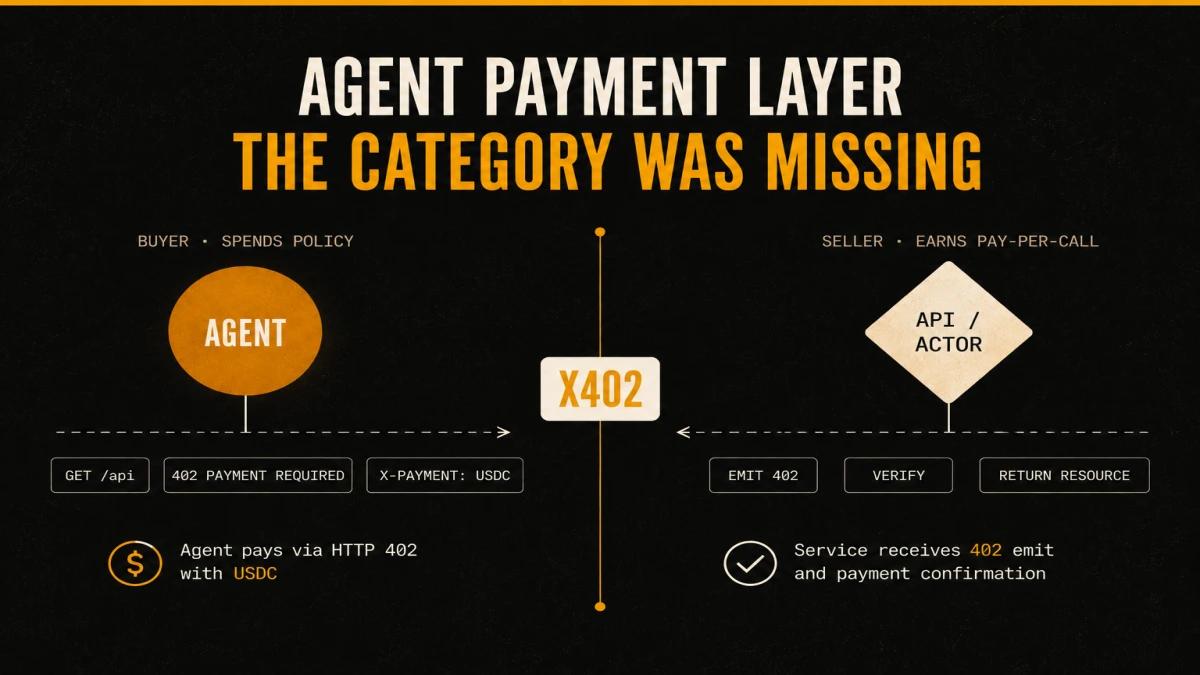
Every operator with a paid digital product, every founder running a SaaS, every service business that bills by the hour will face two questions about agents and money soon.
How does this business get paid when the buyer is an autonomous agent? And how does this business pay when its own agents are doing the spending?
Right now those questions sit on platform engineering desks. Within a year or two they sit on every operator's desk. The plumbing is being laid this quarter. New MCP servers are spinning up every day. Frontier labs are wiring agents into the same models that already write the operator's code and answer the operator's customers. The signal is past the noise floor: Cloudflare-fronted servers emit over a billion HTTP 402 responses every day, and x402.org reports 75 million transactions and $24 million settled in the trailing thirty days. What is left is choosing which side of the rail the business sits on when the inflexion point lands.
The shift goes through the operator differently than the engineer thinks. The engineer asks how the protocol works. The operator asks what changes about getting paid, and what changes about paying. The honest answer is that both change, both are already changing, and the operator who treats it as someone else's problem will end up paying retail for a category their competitors are buying wholesale.
Until x402, the autonomous agent category had a hard ceiling at the moment an agent needed to pay for something. The model could decide what to buy. The agent could halt at the checkout. Card rails assume a human at the keyboard. API-key billing assumes a human signing a contract. Stored credentials are a security and budget liability. Below a few cents per transaction, traditional rails stop being economic at all. Every autonomous workflow that touches paid resources hit the same wall, and the workaround was always the same: a human in the loop. x402 removes the wall.
x402 is a category shift with two sides, receiving and paying. Operators who learn both together stay ahead at both together.
What x402 actually is
HTTP status code 402 has three lives. The article keeps the three separate from here on.
The first life is the status code itself. RFC 7231 reserves 402 for "Payment Required" and annotates it "for future use". The original RFC 2068 included it in 1997. MDN still labels the code "experimental, do not use in production code" as of May 2026. For nearly three decades the line of code waited.
The second life is the protocol. Coinbase published x402 on 2025-05-06 as an open spec that activates the 402 status code for stablecoin payments over HTTP. AWS, Anthropic, Circle, and NEAR co-launched. Erik Reppel, Coinbase Head of Engineering and a co-author of the x402 whitepaper, framed the launch in his own words: "Just like HTTPS secured the web, x402 could define the next era of the internet; one where value moves as freely and instantly as information."
The third life is the foundation. In September 2025, Coinbase contributed the spec to the Linux Foundation as "x402, a Series of LF Projects, LLC", with Cloudflare as co-founder of the x402 Foundation. Coinbase still maintains x402.org. Cloudflare added x402 support to its Agents SDK and MCP server runtime, and proposed a deferred payment scheme that lets servers roll up settlement on a subscription or batch basis. The maintainership shifted from a single-vendor protocol to an industry-led standard with a Governing Board still in formation as of May 2026.
The pattern itself is small. The agent makes an HTTP request. The server returns 402 with a JSON body listing accepted networks, prices, and a destination wallet. The agent signs a payment authorization (EIP-712 / EIP-3009 on EVM chains), retries the request with an X-PAYMENT header, and the server returns the resource with X-PAYMENT-RESPONSE once the facilitator confirms settlement. Settlement on Base completes in approximately 200 milliseconds. Versions matter: x402 V2 launched in December 2025 with wallet-based identity, dynamic payment recipients, and multi-chain support across Base, Ethereum, Polygon, Solana, Avalanche, and Sui.
- 01Server emits HTTP 402
A resource endpoint receives a request without a payment header and replies with status 402 and a JSON body listing accepted networks, schemes, prices, and the destination wallet.
- 02Client signs a payment authorization
The agent's wallet produces an EIP-712 / EIP-3009 signature binding sender, recipient, amount, validity window, and nonce. The signature is gasless for the agent.
- 03Client retries with X-PAYMENT header
The same HTTP request runs again with the signed payload attached. The server forwards the payload to a facilitator (Coinbase, Cloudflare, or self-hosted) for verification and settlement.
- 04Server returns the resource with X-PAYMENT-RESPONSE
Once the facilitator confirms settlement, the server fulfils the original request and emits a confirmation header that the client logs for its own audit trail.
The status code (HTTP 402), the protocol authored by Coinbase and contributed to the Linux Foundation as the x402 Foundation, and the various "x402-style" wrappers shipped by individual vendors are three different things. A claim of "x402 support" can mean any of them. Before integrating, verify which spec the implementation follows, which facilitator it uses, and which networks it settles on.
Why traditional payment rails halt at the agent
Card rails were built for humans at keyboards. Every layer of the legacy stack assumes the human is present, accountable, and available to make decisions when the rail interrupts the flow.
3-D Secure and Strong Customer Authentication exist to prove a human approved the transaction. They send the user a push notification or one-time code. An autonomous agent has no notification surface and no human to forward it to. The rail blocks the transaction.
Stripe and PayPal account creation assumes a human signed terms of service, supplied identity documentation for KYC, and accepted a chargeback policy. Agents that try to provision accounts at runtime trip the same human-required checks. The rail blocks the agent at onboarding.
Stored credentials work, until they don't. An agent that holds a payment method has the budget of whatever balance the card carries, with no per-call ceiling. If the agent's runtime is compromised, so is the card. Every production team that has tried this has built a reactive spending-cap layer on top, because the rail itself does not provide one. The rail leaves the team with a security and budget liability instead of a payment surface.
KYC and chargeback infrastructure assume a human accountable party. Disputes go to that party. Refunds return to that party. Fraud reviews escalate to that party. Inserting an autonomous agent into that chain breaks the assignment of responsibility, and many providers respond by refusing the transaction class entirely.
Below a certain transaction size, traditional rails are uneconomic. Interchange and per-transaction minimums consume sub-cent payments. The Coinbase x402 whitepaper documents fees as high as $0.30 per transaction on traditional cards, which renders microtransactions impractical. Forrester puts it bluntly in its analysis of machine-initiated payments: payment is a prerequisite, not a preference, for agent workflows. An agent cannot substitute a free alternative when the workflow requires a paid resource.
Net result: the autonomous category bumps into the same wall every time. The agent decides. The agent reaches the resource. The agent halts at the rail. The team adds a human-approval step or a reactive spending cap, and the workflow stops being autonomous.
What x402 unlocks
The unlock is small in protocol terms and large in category terms.
Programmatic pay-per-call APIs. No account setup. No stored card. No monthly invoice. The server sets a price per call. The agent pays per call. Allium, Nansen, and Nous Research already operate per-request access for AI agents on this model. An autonomous research agent that needs one Hermes 4 inference can pay for one Hermes 4 inference and continue.
Micropayments at sub-cent levels. Settlement on Base costs roughly 1 cent in onchain gas. With zero protocol fees on the x402 side, the all-in cost per transaction sits an order of magnitude below the cheapest card minimum. Per-token pricing for LLM access, per-image pricing for generation, per-row pricing for analytics, all become economically viable.
Agent-to-agent commerce. One autonomous system pays another to execute a task or supply a result, with no human in either loop. A procurement agent calls multiple service APIs (inventory, logistics, payment) without human involvement. Each request triggers a secure, auditable payment, reducing latency and operational friction. Galaxy Research observed this pattern emerging in late 2025 as agent-to-agent and data-as-a-service categories grew their share of x402 transaction volume away from speculative memecoin minting.
Per-call paywalled content and tools. Cloudflare-fronted sites already emit "over a billion HTTP 402 response codes" daily to bots and crawlers. The Pay-per-Crawl framework introduced in 2024 and integrated with x402 in 2025 turns that signal from a refusal into a price. The same model generalises to any paywalled resource: news articles, research databases, real-time feeds.
Economic autonomy as a category. Coinbase frames the unlock as "economic autonomy for software". The autonomous harness gains a new layer. Where the harness used to control what the agent does, it now also controls what the agent spends.
| Criteria | x402 (stablecoin) | Stripe (cards via 3DS/SCA) | API key + monthly invoice | Wallet-stored card |
|---|---|---|---|---|
| Human required at transaction | Yes (3DS) | No (after onboarding) | No (after enrolment) | |
| Micropayment viable (sub-cent) | No (interchange + min fee) | No (rounded to invoice) | No (interchange) | |
| Agent-native flow | No (assumes browser) | No (assumes back-office) | Partial (limits retrofitted) | |
| Audit surface | On-chain ledger plus facilitator log | Stripe dashboard plus webhook | Internal billing DB | Card statement |
| Dispute model | None native; recourse lives in harness or wallet policy | Chargeback (regulated) | Invoice dispute (manual) | Chargeback (regulated) |
| Typical implementation cost | One middleware line plus facilitator account | SDK plus 3DS flow plus KYC | Account provisioning plus ops | Card issuance plus risk management |
Implementations in the wild
The ecosystem has organised quickly into a layered stack with multiple players per layer.
Execution and settlement is x402. Coinbase authored the spec, contributed it to the Linux Foundation, and runs the most-used facilitator. Settlement defaults to Base with USDC, chain-agnostic across EVM plus Solana. Production deployments include Hyperbolic (GPU inference), OpenMind (robotics), Anthropic MCP, NEAR AI, XMTP, Neynar, Cal.com, and BuffetPay (with built-in spending guardrails).
Authorization and trust is AP2. Google launched it in September 2025 with sixty-plus partners (Adyen, Amex, Mastercard, PayPal, Coinbase, Revolut, Worldpay). AP2 defines three mandate types (Intent, Cart, Payment) as cryptographically signed JSON-LD objects that travel with the agent and prove authorisation. The A2A x402 extension, co-developed by Coinbase, Google, MetaMask, and the Ethereum Foundation, binds AP2's framework to x402's settlement.
Stripe anchors two layers. ACP, co-developed with OpenAI under Apache 2.0, is the conversational checkout layer; it deployed in ChatGPT Instant Checkout in February 2026 before pivoting to an app-based model in March. MPP, co-developed with Tempo and launched on 2026-03-18, is the session and rail-bridging layer; an agent pre-authorises a spending cap once and streams micropayments inside that session. Stripe accepts both MPP and x402 at the API layer, which makes them siblings rather than rivals.
Card networks shipped extended derivatives in 2025. Visa Intelligent Commerce plus the Trusted Agent Protocol (October 2025), and Mastercard Agent Pay (rolled out to all US cardholders by November 2025, with Europe's first agent-initiated payment completed with Santander in early 2026) preserve chargeback semantics at the cost of per-call economics.
Wallets and identity is Skyfire and Crossmint. Skyfire ships the Know Your Agent (KYA) protocol on JSON Web Tokens for verifiable agent identity. Crossmint ships agent wallets with programmable spending controls (per-transaction limits, merchant whitelists, human approval thresholds), supports both x402 and card rails, and issues virtual Visa/Mastercard cards alongside USDC accounts.
Marketplaces are running both rails today
The cleanest demonstration of the two-sided model in production today is Apify. The Apify Store hosts thousands of Actors. Actors are runnable scrapers, automations, and AI agents that builders publish for revenue. Apify's hosted MCP server at mcp.apify.com exposes those Actors as discoverable tools to MCP-compatible clients including Claude, ChatGPT, and any agent runtime that speaks the protocol.
On the receiving side, a builder publishes an Actor with the Pay-Per-Event pricing model and earns USDC every time an agent runs it through the Apify MCP server with x402 enabled. The agent runs without an Apify account; payment settles on Base over HTTP. The builder treats the Actor as a product, and the marketplace handles the rail.
On the paying side, an operator's agent can autonomously discover Actors, decide which ones the workflow needs, and pay for the runs through Skyfire's pre-funded wallet. The flow has no per-call human approval step, no stored credentials, and no API-key liability. The operator funds the wallet, sets a spending policy, and reads the deliverables. The transactions happen at a layer below the operator's attention.
Both sides ship today. The pattern is copyable. An operator with paid digital resources can publish them as Actors and earn agent traffic. An operator with autonomous workflows can buy capabilities the same way. Builder and buyer can be the same business, sometimes on the same workflow.
Disclosure: Automation Switch is an Apify affiliate. The integration is recommended because both rails are already shipping in production documentation. The link in this section routes through our affiliate program at no cost to the reader; the editorial choice would be the same without it.
Forrester reads the same map and calls it "an emerging stack, not a single winner". Pick the layer that matches the workload, then compose upward.
Stablecoin transactions skip the chargeback layer. If an agent purchase goes wrong on a pure x402 rail, recourse lives in the harness's spending policy and the wallet provider's controls. Card-rail-extended frameworks (Visa Intelligent Commerce, Mastercard Agentic Tokens) preserve chargeback semantics; pure x402 deployments leave that recourse to the wallet. Plan accordingly.
The governance question
The protocol is small. The governance surface is large. Production teams discover the gap as soon as they ship.
Who authorises a payment? The spec answers "whoever holds the signing key", which is correct as a primitive and useless as a policy. Real deployments need an answer for: how much can this agent spend per call, per task, per day, per tenant? That answer lives at the harness layer, where AGENTS.md and permission gates already encode similar policies for tool access and shell commands. AP2 mandates encode an authorization slice of the same problem. Skyfire's KYA encodes the agent-identity slice. Crossmint encodes the wallet-control slice. The harness has to compose them.
Where do spending limits live? Above the protocol, in the harness. The mark3labs/x402-go issue tracker has an open feature request for spending limits and circuit breakers, citing three upstream Coinbase issues on settlement-failure recovery. The PaySentry reference implementation builds a policy engine, spend tracker, and circuit breaker on top of the protocol, because the spec stops at verify-and-settle. The pattern is clear: everything that turns "verify and settle" into a governable operator surface lives in the harness and the wallet.
Audit trail. Every x402 payment becomes an onchain ledger entry plus a facilitator log entry. Reconciling those entries with the agent's task log, the user's tenant, and the budget envelope is harness work. Galaxy Research breaks x402 itself into agent → coordination → facilitation → currency → blockchain layers, and notes that "constraint enforcement (rules or limits such as budget, timing, or permissions)" is a coordination-layer concern, not a settlement-layer one.
Dispute handling. The protocol leaves it to the harness. Card-extended rails handle it directly (chargeback, regulated recourse). The AEI policy framing is honest: "the card network model provides proven fraud protection, consumer recourse, and regulatory accountability. The x402 crypto model offers censorship resistance, low transaction minimums, and programmability that legacy rails truly cannot match. These are not simple trade-offs." The procurement decision turns on whether the workload tolerates settlement finality.
Multi-tenant isolation. Spending caps per tenant, per agent, per task. Policy files describing budget posture. Hard ceilings the runtime enforces before signing. All of these are harness concerns. The four operator non-negotiables (permissions, observability, audit, multi-tenant isolation) extend cleanly into the agent commerce layer.
Security gaps in the default flow. 7BlockLabs documents replay attacks and double-spend windows under "verify-then-serve" semantics, particularly when EIP-712 domain handling diverges across chains (e.g. Polygon bridged USDC uses a different domain separator than native USDC). Mitigations require binding the signed intent to the HTTP request, adding idempotency keys, and gating fulfillment on settlement milestones rather than verification milestones. The primitives are sound. The defaults are permissive. The harness has to tighten the defaults.
The diagnostic framing for an operator: x402 is a payment rail. Governance is a runtime concern, and the runtime currently ships without it. Filling that gap is real consultancy work, because it crosses the protocol boundary into policy, observability, and audit reconciliation.
Implications for the autonomous harness category
A harness without payment capability has a budget ceiling defined by stored credentials. The team prefunds a card or an account, the agent works within that envelope, and the procurement question is "does the runtime run my agents?". For background on what an autonomous harness is and how it differs from an agent framework, see our explainer on the agent harness category.
A harness with x402 (or MPP, or a card-extended derivative) has a budget ceiling defined by spending policy. The agent transacts on demand, the runtime enforces the policy on every paid call, and the procurement question changes shape: "does the runtime enforce my spending policy on every paid call my agents make?".
That is a different question. It maps to a different buyer's-guide criteria set. The four operator non-negotiables extend:
- Permissions extend from tool access to spending authorisation.
- Observability extends from task logs to ledger reconciliation.
- Audit extends from action history to payment history.
- Multi-tenant isolation extends from data boundaries to budget boundaries.
Forrester's read: payment is a prerequisite for agent workflows, not a preference, and the agent ecosystem is converging on layered standards rather than a single platform. The implication for the harness category is that an "economically autonomous" harness is the next category beat after "operationally autonomous". Vendors that treat the payment surface as a shipping concern will outrun vendors that treat it as an integration to add later.
For platform teams, the procurement decision is concrete:
- Pick the rail per workload class. Per-call API and inference workloads favour x402. Consumer e-commerce favours card-extended rails. Many production deployments use both.
- Select for spending governance, not just for protocol support. The protocol is table stakes. The policy engine, the budget enforcer, the audit reconciler, the dispute escalator: those are the differentiators.
- Treat
AGENTS.md(and any equivalent policy file) as the place where spending posture is declared. Cross-platform spending rules should live alongside cross-platform tool rules, in the same surface the harness already reads.
The autonomous agent category had a payment problem. x402 plus the surrounding stack closes that problem at the protocol layer. The harness layer above it is where the real procurement decisions land next.
The category shift, not a feature
The autonomous agent category had a hard ceiling at the moment an agent needed to pay for something. The model could decide. The agent halted at the rail. The team wrote a workaround that put a human in the loop. Every time. x402 closes that gap at the protocol layer, the surrounding stack (AP2, ACP, MPP, KYA, Crossmint controls) closes the rest of the gap at the policy and identity layer, and the harness layer above all of it inherits a new responsibility: enforcing spending policy on every paid call the agent makes.
For platform teams evaluating the agent commerce layer right now, three questions land before the integration choice:
- Which rail matches the workload? Per-call APIs and inference favour x402. Consumer e-commerce favours card-extended derivatives.
- Where does spending governance live in the runtime? At the harness layer. The protocol leaves the gap open.
- Which adjacent standards (AP2, ACP, MPP) does the team need to interop with, and how do they compose at the wallet?
The answer to those questions is harder than the protocol choice. It is also where consultancy starts being relevant, because the spec stops where the policy begins.
Two questions every operator faces. One protocol that closes the gap. One harness layer that decides whether the closure holds.